
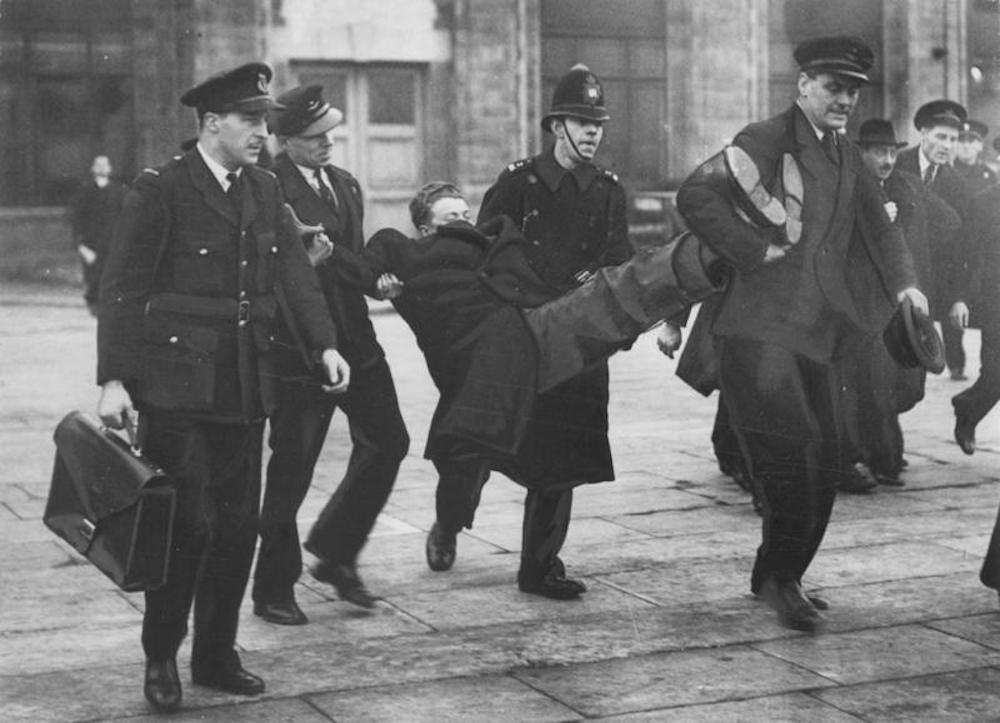
This is the opening to my essay on what old debates about Jewish refugees tell us about the immigration debate today, published in the Observer on 17 August 2025. You can read the full version in the Observer.
“East of Aldgate one walks into a foreign town”, foreigners “swamping whole areas once populated by English people”. The “substitution of a foreign for an English population” has created “increasing bitterness of feeling”.
No, not Robert Jenrick or Nigel Farage, but William Evans-Gordon, the Tory MP for Stepney, fulminating in 1903 against the arrival of Jewish refugees fleeing pogroms in eastern Europe. “Not a day passes but English families are ruthlessly turned out to make room for the foreign invaders,” he told parliament.
Evans-Gordon was a founder of the British Brothers’ League (BBL), a powerful anti-immigration movement with the slogan “England for the English”, and the driving force behind the 1905 Aliens Act, designed to keep out Jewish refugees.
Where previous arrivals had “merged in the population”, Evans-Gordon wrote in The Alien Immigrant, “the Hebrew colony” formed a “permanently distinct block – a race apart”, refusing to “assimilate” but coming “like an army of locusts, eating up the English inhabitants or driving them out”.
They brought with them “colonies of foreign crime”. In certain courts in London, “English was hardly heard”. According to Evans-Gordon: “The proportion of aliens who live by vice is inordinately high”. They indulged in “depraved” sexual crimes, “which, but for them, would hardly be known in this country”.
Evans-Gordon’s themes echo across the century. Arguments about populations being replaced, denunciations of asylum seekers as “invaders”, the insistence that migrants are unassimilable, accusations of mass criminality and depravity, are all wearily familiar.
One can even hear in Evans-Gordon the contempt for what many now call the “liberal elite”. The “wholesale displacement of our people,” he wrote, “is regarded with much philosophic calm by their fellow countrymen who live at a distance, whose homes have not been invaded, and who are not subjected to the daily terror of being turned into the streets.” That might have been Matthew Goodwin.
Read the full version of the essay in the Observer.
 Pandaemonium